
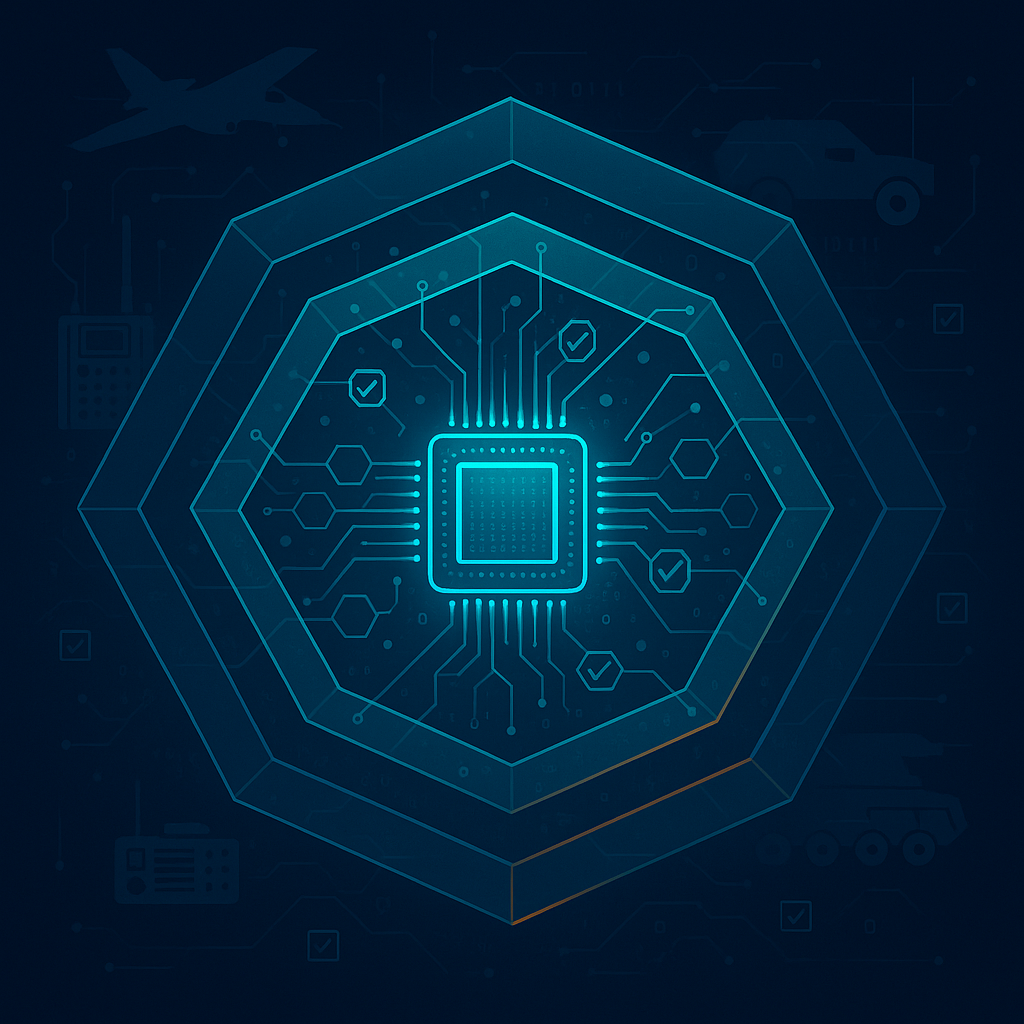
High-Assurance Embedded Security
Trusted execution for mission systems—so only the right code runs, and you can prove it.
At the mission edge, software rides on contested networks, complex supply chains, and tight real-time constraints. Patching isn’t always possible, connectivity isn’t guaranteed, and “trust but verify” has to happen on platform. Our trusted execution technology provides a security-first runtime that hardens critical functions and continuously proves integrity—without breaking mission timing.
At its core is a U.S.-developed trusted execution environment designed for defense programs. It establishes a hardware-anchored root of trust, partitions the platform into isolated domains, and enforces secure boot and measured boot. From there, it offers continuous attestation—evidence that the right software is running—and a secure host for zero-trust communications and cryptographic services.
How it works in program terms:
Partition & protect. Isolate safety- and mission-critical workloads from less-trusted software while preserving real-time behavior.
Boot with proof. Verify every stage from power-on; record measurements that can be checked pre-mission or in the loop.
Attest at runtime. Provide continuous, queryable evidence of software identity and state to commanders, C2, or other authorized verifiers.
Contain & recover. Constrain faults or compromises to their domain and support safe recovery paths.
Enable zero-trust on platform. Run secure networking stacks and key management inside a protected execution context.
Deliver evidence. Produce artifacts and logs that accelerate RMF/ATO reviews and support sustainment.
What makes this different is that it’s purpose-built for embedded mission systems, not repurposed from mobile or cloud tech. The trusted computing base is lean, the integration model is developer-friendly, and it supports mixed-criticality deployments across Linux, RTOS, and bare-metal components. It also targets modern defense-relevant SoCs—including AMD/Xilinx—so programs can harden fieldable platforms without exotic hardware.
Where it helps most: mission computers, radios and payloads, autonomy controllers, secure weapon interfaces—any platform where assurance, isolation, and proof matter as much as performance. It stands alone as the secure runtime, and it also pairs naturally with our AI-enabled RF/cyber analysis (to rapidly address discovered weaknesses) and digital-engineering pipelines (to validate and deploy configurations faster).
If you need a defensible way to say “we know exactly what is running, and it’s the right thing,” this is how you get there.